In this article
- Where Do Cheetahs Live in Africa?
- Cheetah Habitat
- Where Are Cheetahs Found?
- Cheetah Natural Habitat
- Do Cheetahs Live in the Savanna?
- Do Cheetahs Live in Grasslands?
- Do Cheetahs Live in Deserts?
- Do Cheetahs Live in Forests?
- Where Do Cheetahs Live in Southern Africa?
- Namibia
- Botswana
- South Africa
- Zimbabwe
- Zambia
- Angola and Mozambique
- Where Do Cheetahs Live in East Africa?
- Do Cheetahs Live Outside Protected Areas?
- Why Do Cheetahs Need Large Areas?
- What Do Cheetahs Eat in Their Natural Habitat?
- How Do Cheetahs Hunt?
- Where Do Cheetahs Sleep?
- Why Are Cheetah Populations Declining?
- Cheetah Range Today
- Are Cheetahs Endangered?
- Frequently Asked Questions
- Where do cheetahs live?
- Where do cheetahs live in Africa?
- Do cheetahs live in the savanna?
- Do cheetahs live in deserts?
- Do cheetahs live in forests?
- What countries have wild cheetahs?
- Are cheetahs endangered?
- How much of their historic range do cheetahs occupy?
- Conclusion
The cheetah is one of Africa’s most recognizable wild cats. Known for speed, agility and its spotted coat, the cheetah lives across a much smaller range than in the past.
So, where do cheetahs live?
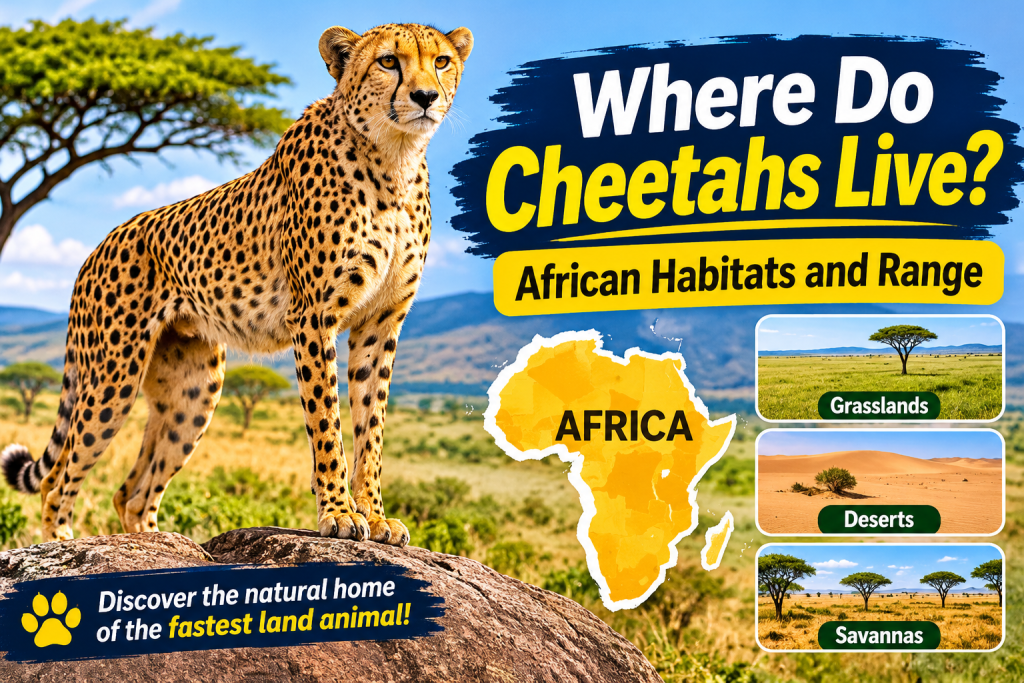
Most wild cheetahs live in parts of sub-Saharan Africa. Small populations also survive in North Africa, the Horn of Africa and Iran. Their present range is highly fragmented compared with their historical distribution [1].
Cheetahs use several types of habitat. These include grasslands, savannas, dry forests, scrublands, semi-deserts and some desert environments [2].
Where Do Cheetahs Live in Africa?
Cheetahs live mainly across eastern, southern and parts of central and northern Africa.
Important populations occur in countries such as:
- Namibia
- Botswana
- South Africa
- Zimbabwe
- Zambia
- Tanzania
- Kenya
- Uganda
- Ethiopia
- Somalia
- Mozambique
- Angola
The exact distribution differs between countries. Many populations are small and separated from one another by human development, farmland and other land-use changes [1][3].
Namibia, Botswana and South Africa contain important populations in southern Africa. Kenya and Tanzania are also important countries for wild cheetahs in East Africa [3].
Read: What Do Giraffes Eat in the Wild? | Complete Giraffe Diet Guide
Cheetah Habitat
A cheetah habitat needs more than open land.
Cheetahs need enough prey, water and suitable cover. Large connected areas are important because cheetahs often have extensive home ranges [1].
Suitable habitats include:
- African savannas
- Open grasslands
- Dry woodlands
- Scrublands
- Semi-arid areas
- Dry forests
- Some desert regions
Cheetahs generally avoid dense tropical forests and montane forests. Their body structure and hunting method are better suited to open landscapes where they have room to chase prey [2].
Where Are Cheetahs Found?
Wild cheetahs are found mainly in Africa.
The largest remaining concentration occurs in southern Africa. The Cheetah Conservation Fund reports Namibia, Botswana, South Africa, Angola, Zambia and Mozambique as part of a major southern African population area [1].
East Africa also supports important populations, especially in Kenya and Tanzania.
A small population of Asiatic cheetahs survives in Iran [1].
Also Read: What Do Elephants Eat? Complete African Elephant Diet Guide
Cheetah Natural Habitat
The natural habitat of a cheetah varies across Africa.
Some cheetahs live in open grasslands with scattered trees. Others live in dry bushland, woodland and semi-arid landscapes.
The species has a broad habitat tolerance. An IUCN assessment describes cheetahs living across habitats ranging from dry forests and thick scrub to grasslands and hyperarid deserts [2].
This flexibility helps explain why cheetahs have survived across different African environments.
Do Cheetahs Live in the Savanna?
Yes.
African savannas provide suitable habitat for cheetahs because open grassland gives them space to move and hunt.
Savanna environments also support prey species such as gazelles, impalas and other small to medium-sized antelopes [1].
Cheetahs do not need completely treeless land. Scattered trees, shrubs and other vegetation provide shade and cover.
Do Cheetahs Live in Grasslands?
Yes.
Grasslands are among the habitats used by wild cheetahs.
Open grassland gives a hunting cheetah enough space to approach prey and make a high-speed chase.
Grassland also supports many herbivores, creating an important food supply.
Still, cheetahs are not restricted to grasslands. Their range includes several other habitat types [2].
Do Cheetahs Live in Deserts?
Some cheetahs live in very dry environments.
Cheetahs have been recorded in arid and hyperarid regions, including parts of the Sahara and other dry landscapes [2].
The ability to survive in dry environments depends on available prey, water and suitable cover.
Cheetahs living in Namibia are especially associated with dry landscapes and farmland areas [1].
Do Cheetahs Live in Forests?
Cheetahs use some dry forest and woodland habitats.
Dense tropical forests are generally unsuitable for cheetahs because such environments restrict their preferred hunting strategy [2].
Dry woodland and open forest with enough clear ground provide better conditions.
The difference is important because the word “forest” covers many habitat types.
Where Do Cheetahs Live in Southern Africa?
Southern Africa holds one of the most important remaining groups of wild cheetahs.
Important range countries include:
Namibia
Namibia supports a large cheetah population. Many Namibian cheetahs live outside formally protected areas, including on commercial and communal farmland [1].
Botswana
Botswana contains important free-ranging cheetah populations. Many animals live outside protected areas and share landscapes with livestock farmers [3].
South Africa
Cheetahs occur in protected areas and managed landscapes across South Africa.
Zimbabwe
Zimbabwe is another southern African range country with wild cheetahs.
Zambia
Cheetahs occur in several landscapes across Zambia.
Angola and Mozambique
Both countries form part of the wider southern African cheetah range [1].
Where Do Cheetahs Live in East Africa?
East Africa remains an important region for wild cheetahs.
Kenya and Tanzania support notable populations.
Cheetahs occur in landscapes containing grasslands, savannas and other open habitats.
Protected areas and surrounding community lands both play roles in maintaining suitable habitat.
Do Cheetahs Live Outside Protected Areas?
Yes.
A large share of Africa’s remaining cheetahs live outside formally protected areas.
The Cheetah Conservation Fund reports that more than 75 percent of African cheetahs live on rural farmland alongside human communities.
This creates a major conservation challenge.
Farmers depend on livestock and land for their livelihoods. Cheetahs depend on the same broader landscape for habitat and prey.
Reducing conflict between people and wildlife is therefore an important part of cheetah conservation.
Why Do Cheetahs Need Large Areas?
Cheetahs have large space requirements.
Their habitat needs include enough prey, water and suitable cover. Fragmented habitat makes movement between feeding and breeding areas harder [4].
A landscape might still look suitable for wildlife while roads, farms and settlements divide the area into smaller pieces.
Connected habitat therefore has an important role in maintaining viable cheetah populations.
What Do Cheetahs Eat in Their Natural Habitat?
Cheetahs mainly hunt small to medium-sized prey.
Common prey includes:
- Thomson’s gazelles
- Impalas
- Other small antelopes
- Hares
- Birds
- Rodents
Cheetahs sometimes take young animals from larger species.
Their prey selection depends on the animals available in each habitat.
How Do Cheetahs Hunt?
Cheetahs usually rely on speed and close-range pursuit.
A cheetah first approaches prey before beginning a rapid chase.
Its flexible spine, long legs, large nasal passages and specialized body structure support high-speed running.
The chase usually lasts only a short time because sprinting requires substantial energy.
Open habitat therefore provides an important advantage.
Where Do Cheetahs Sleep?
Cheetahs rest in shaded areas during periods of heat.
They often use tall grass, bushes, trees or other available cover.
Unlike some predators, cheetahs do not depend on caves or permanent dens for resting.
Females with cubs use concealed locations to protect young cubs during the early stages of life.
Why Are Cheetah Populations Declining?
Several threats affect wild cheetahs.
The major threats include:
- Habitat loss
- Habitat fragmentation
- Loss of prey
- Human-wildlife conflict
- Illegal wildlife trade
- Competition with larger predators
The Cheetah Conservation Fund identifies human-wildlife conflict, habitat loss and illegal wildlife trade among the major threats facing the species.
Competition with lions, leopards and hyenas also affects cheetahs, especially in areas with high densities of larger predators [1].
Cheetah Range Today
The cheetah’s current range is much smaller than its historical range.
The Cheetah Conservation Fund reports that wild cheetahs occupy roughly 9 percent of their historic range.
This decline has left populations scattered across separate areas.
The remaining populations therefore need suitable habitat, sufficient prey and safe movement routes.
Read: What Do Lions Eat in the Wild? | Complete Lion Diet Guide
Are Cheetahs Endangered?
The cheetah is listed as Vulnerable on the IUCN Red List [1].
The conservation situation differs between populations and regions.
Some populations are small, isolated and exposed to serious threats.
The Asiatic cheetah is especially restricted, with fewer than 50 individuals reported in Iran by the Cheetah Conservation Fund [1].
Frequently Asked Questions
Where do cheetahs live?
Most wild cheetahs live in parts of sub-Saharan Africa. Small populations also occur in North Africa, the Horn of Africa and Iran.
Where do cheetahs live in Africa?
Cheetahs live across parts of eastern, southern, central and northern Africa. Namibia, Botswana, South Africa, Kenya and Tanzania are among the important range countries.
Do cheetahs live in the savanna?
Yes. Savannas provide suitable open habitat and support many prey species hunted by cheetahs [1].
Do cheetahs live in deserts?
Yes. Cheetahs occur in some arid and hyperarid environments, including parts of the Sahara and southern Africa.
Do cheetahs live in forests?
Cheetahs use some dry forest and woodland habitats, but dense tropical forests are generally unsuitable [2].
What countries have wild cheetahs?
Wild cheetahs occur in several African countries, including Namibia, Botswana, South Africa, Zimbabwe, Zambia, Tanzania, Kenya, Uganda, Ethiopia, Somalia, Mozambique and Angola [3].
Are cheetahs endangered?
The cheetah is classified as Vulnerable on the IUCN Red List. Populations vary considerably by region, with some facing severe local threats.
How much of their historic range do cheetahs occupy?
The Cheetah Conservation Fund reports that cheetahs now occupy about 9 percent of their historic range.
Conclusion
Cheetahs live mainly across open and semi-open habitats in Africa.
Savannas, grasslands, dry woodlands, scrublands and some desert environments provide suitable conditions for different cheetah populations [2].
Southern Africa and East Africa remain important regions for wild cheetahs. Yet much of the remaining population lives outside protected areas, where wildlife shares land with farming communities [1].
Protecting connected habitat, maintaining prey populations and reducing conflict between people and cheetahs are important parts of long-term conservation.
Related wildlife stories



Animals are blessing to mankind
I love Animals