In this article
- Cheetah vs Leopard: Quick Comparison
- 1. What Is the Difference Between a Cheetah and a Leopard?
- 2. Cheetah vs Leopard: Size and Weight
- 3. Cheetah vs Leopard: Speed
- 4. Cheetah vs Leopard: Physical Appearance
- Cheetah Appearance
- Leopard Appearance
- 5. Cheetah vs Leopard: Habitat and Geographic Distribution
- Where Do Cheetahs Live?
- Where Do Leopards Live?
- 6. Cheetah vs Leopard: Diet and Feeding
- What Do Cheetahs Eat?
- What Do Leopards Eat?
- 7. Cheetah vs Leopard: Hunting Methods
- How Do Cheetahs Hunt?
- How Do Leopards Hunt?
- 8. Cheetah vs Leopard: Behavior and Social Life
- Cheetah Behavior
- Leopard Behavior
- 9. Cheetah vs Leopard: Climbing Ability
- 10. Cheetah vs Leopard: Reproduction and Cubs
- Cheetah Reproduction
- Leopard Reproduction
- 11. Cheetah vs Leopard: Threats and Predators
- Cheetah Threats
- Leopard Threats
- 12. Cheetah vs Leopard: Which Animal Is Stronger?
- 13. Are Cheetahs and Leopards Related?
- 14. Cheetah vs Leopard: Which Is More Dangerous to Humans?
- Frequently Asked Questions
- 1. Is a cheetah faster than a leopard?
- 2. Is a leopard bigger than a cheetah?
- 3. Can a leopard kill a cheetah?
- 4. Do cheetahs and leopards live in the same habitat?
- 5. Which animal climbs trees better?
- 6. Do cheetahs have rosette spots?
- 7. Which animal has a stronger bite?
- 8. Are cheetahs and leopards endangered?
- Bottom Line
- Sources
Cheetahs and leopards are two of Africa’s most recognizable wild cats. Both have spotted coats, sharp teeth and impressive hunting abilities. They also live in some of the same African habitats.
Despite their similar appearance, these animals have major differences. The cheetah is built for speed and relies on short, high-speed chases to catch prey. The leopard has a stronger, heavier body and uses stealth, strength and ambush tactics to hunt.
So, what is the difference between a cheetah and a leopard?
This post compares their size, weight, speed, appearance, diet, hunting methods, habitats and behaviour. You will also learn how to identify each animal in the wild.
Cheetah vs Leopard: Quick Comparison
| Feature | Cheetah | Leopard |
| Scientific name | Acinonyx jubatus | Panthera pardus |
| Animal family | Felidae | Felidae |
| Conservation status | Vulnerable | Vulnerable |
| Body shape | Slim and lightweight | Muscular and stocky |
| Coat pattern | Solid black spots | Black rosette-shaped markings |
| Face | Black tear marks | No black tear marks |
| Average weight | 34–64 kg | Approximately 17–90 kg |
| Top speed | Around 96–112 km/h in short bursts | Around 55–60 km/h, depending on individual and conditions |
| Hunting method | Stalking followed by a fast chase | Stalking and ambush |
| Main prey | Gazelles, impalas and other small to medium-sized animals | Antelopes, deer, monkeys, rodents and other animals |
| Activity | Mainly daytime | Often nocturnal, crepuscular or active during the day |
| Climbing ability | Climbs, but less specialised | Excellent tree climber |
| Social behaviour | Females usually solitary, males sometimes form coalitions | Mostly solitary |
| Geographic range | Mainly Africa, with a small population of Asiatic cheetahs in Iran | Parts of Africa and Asia |
1. What Is the Difference Between a Cheetah and a Leopard?
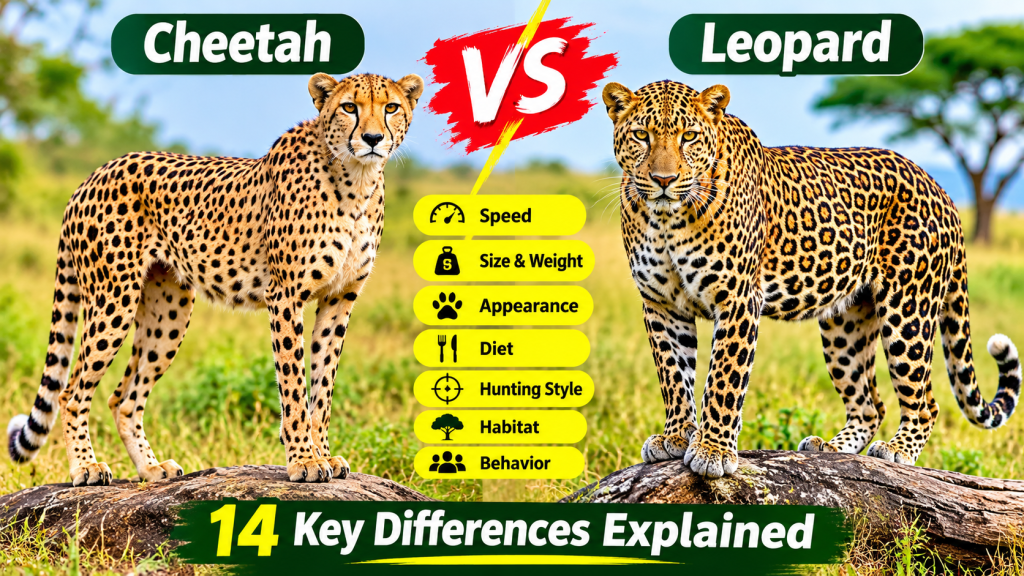
The biggest difference between a cheetah and a leopard is their physical build and hunting strategy.
A cheetah has a slim body, long legs, a small head and a flexible spine. These features help the animal accelerate quickly and chase prey across open ground.
A leopard has a heavier body, strong shoulders, powerful jaws and muscular legs. These features help it overpower prey, climb trees and carry heavy kills.
Their coats also provide an easy way to tell them apart. Cheetahs have small, solid black spots, while leopards have larger markings called rosettes. A cheetah also has distinctive black tear marks running from the inner corners of its eyes down towards its mouth.
2. Cheetah vs Leopard: Size and Weight
Leopards generally have a heavier and more muscular build than cheetahs.
An adult cheetah usually weighs between 34 and 64 kg. Its body measures approximately 112–142 cm in length, excluding the tail.
Leopards show greater variation in body size across their geographic range. Adults generally weigh between 17 and 90 kg, with males often considerably heavier than females.
The leopard’s powerful shoulders and forelimbs help it climb trees and lift prey. The cheetah’s lighter frame supports rapid acceleration and high-speed running.
Which animal is bigger?
The leopard is generally heavier and more muscular than the cheetah.
3. Cheetah vs Leopard: Speed
The cheetah is the world’s fastest land mammal. During short sprints, it reaches approximately 96–112 km/h.
Its long legs, flexible spine, specialised paws and semi-retractable claws help it accelerate and change direction while chasing prey.
A leopard is slower, with commonly reported top speeds around 55–60 km/h. Its body prioritises strength, balance and climbing ability rather than extreme sprinting.
The cheetah also has a limitation. It cannot maintain maximum speed for long. A high-speed chase places considerable physical demands on its body.
Which animal is faster?
The cheetah is much faster than the leopard over short distances. The leopard relies more on stealth and strength when hunting.
4. Cheetah vs Leopard: Physical Appearance
Their spotted coats often cause confusion, but several features make identification easier.
Cheetah Appearance
A cheetah has:
- A slim, athletic body.
- Long legs and a relatively small head.
- Small, solid black spots across its coat.
- Distinctive black tear marks running from its eyes towards its mouth.
- A long tail with dark rings near the tip.
- Semi-retractable claws that provide traction while running.
Leopard Appearance
A leopard has:
- A muscular body with strong shoulders.
- A broad head and powerful jaws.
- Rosette-shaped markings across much of its coat.
- Shorter, stronger limbs compared with a cheetah.
- A long tail that helps with balance.
- Fully retractable claws suited to climbing and gripping prey.
How do you identify them quickly?
Look at the face and coat. Black tear marks and solid spots indicate a cheetah. Rosette markings and a heavier body indicate a leopard.
5. Cheetah vs Leopard: Habitat and Geographic Distribution
Both animals live in Africa, and their geographic ranges overlap in several regions. They also occupy different parts of Asia.
Where Do Cheetahs Live?
Cheetahs mainly inhabit parts of eastern, southern and northeastern Africa. They prefer open landscapes where they have enough space to spot and chase prey.
Their habitats include:
- African savannas.
- Open grasslands.
- Semi-arid regions.
- Scrublands.
- Some mountainous and dry landscapes.
A small population of Asiatic cheetahs survives in Iran.
Where Do Leopards Live?
Leopards have a wider habitat range. They live in parts of Africa and Asia and adapt to many different environments.
Their habitats include:
- Tropical rainforests.
- African savannas.
- Mountain forests.
- Woodlands.
- Grasslands.
- Rocky areas.
- Semi-deserts.
Leopards also live close to human settlements in some regions, although human activity creates serious risks for their survival.
Which animal has a wider habitat range?
The leopard has a broader geographic and habitat range. Its ability to live in forests, mountains, grasslands and dry environments makes it highly adaptable.
6. Cheetah vs Leopard: Diet and Feeding
Both animals are carnivores, meaning they depend on animal flesh for food. Their prey choices differ according to body size, hunting ability and habitat.
What Do Cheetahs Eat?
Cheetahs mainly hunt small and medium-sized animals.
Their common prey includes:
- Thomson’s gazelles.
- Impalas.
- Springboks.
- Hares.
- Ground-dwelling birds.
- Young antelopes.
Cheetahs often select vulnerable or isolated animals. Their hunting strategy depends on getting close before launching a short, fast chase.
What Do Leopards Eat?
Leopards have a wider prey-size range. Their muscular bodies allow them to hunt animals larger than those typically targeted by cheetahs.
Their diet includes:
- Antelopes.
- Deer.
- Monkeys.
- Baboons.
- Wild pigs.
- Rodents.
- Birds.
- Reptiles.
Leopards are opportunistic hunters. They often take their kills into trees to reduce the risk of losing food to other predators.
Which animal hunts larger prey?
Leopards generally hunt a wider range of prey sizes and often tackle larger animals than cheetahs.
7. Cheetah vs Leopard: Hunting Methods
Their hunting techniques reveal some of their biggest differences.
How Do Cheetahs Hunt?
Cheetahs depend heavily on eyesight. They scan their surroundings, identify potential prey and approach quietly.
Their hunting process usually involves:
- Spotting prey from a distance.
- Selecting a suitable target.
- Stalking the animal through grass or other cover.
- Launching a high-speed chase.
- Knocking the prey off balance.
- Gripping the throat to suffocate the animal.
Cheetahs mainly hunt during daylight, often in the early morning and late afternoon.
How Do Leopards Hunt?
Leopards rely on stealth and ambush.
They approach prey quietly, using trees, rocks, bushes and thick vegetation as cover. Once close enough, they launch a sudden attack.
Their powerful jaws and muscular bodies help them overpower prey. Leopards often use a bite to the throat or neck to kill their target.
Unlike cheetahs, leopards frequently drag their kills into trees or dense vegetation. This helps protect their food from scavengers and competing predators.
8. Cheetah vs Leopard: Behavior and Social Life
Cheetahs and leopards generally live solitary lives, but their social structures differ.
Cheetah Behavior
Female cheetahs usually live alone, except when raising cubs.
Male cheetahs sometimes form groups called coalitions. These groups often consist of brothers from the same litter, although unrelated males sometimes form coalitions.
Cheetahs communicate through chirps, purrs, growls, hisses and scent marking. They are mainly active during daylight.
Leopard Behavior
Leopards are mostly solitary and territorial. Adults usually meet during mating periods or when mothers raise cubs.
They communicate through scent marking, scratch marks, vocalisations and other signals.
Leopards often become active at night, although their activity patterns vary with location, prey availability and human disturbance.
9. Cheetah vs Leopard: Climbing Ability
Leopards are much better climbers than cheetahs.
Their powerful forelimbs, strong shoulders and retractable claws help them climb trees while carrying prey.
A leopard often rests on tree branches and uses elevated positions to protect its kill.
Cheetahs also climb trees in some areas, particularly trees with low, sloping branches. However, their bodies and claws are less specialised for climbing.
Which animal is the better climber?
The leopard is the stronger and more skilled climber.
10. Cheetah vs Leopard: Reproduction and Cubs
Both species give birth to live young and depend on maternal care during early development.
Cheetah Reproduction
Female cheetahs usually give birth to between one and six cubs after a pregnancy lasting approximately 90–95 days.
The mother raises the cubs alone and moves them between hiding places to reduce the risk of predators finding them.
Young cheetahs gradually learn hunting skills by following and observing their mother.
Leopard Reproduction
Female leopards usually give birth to two or three cubs after a pregnancy lasting approximately 90–105 days.
They give birth in protected locations such as caves, dense vegetation and rocky shelters.
The mother raises her cubs alone, teaches them to hunt and protects them until they become independent.
11. Cheetah vs Leopard: Threats and Predators
Both species face threats from human activities and natural competition.
Cheetah Threats
Cheetahs face several conservation challenges:
- Habitat loss and fragmentation.
- Declining wild prey populations.
- Human-wildlife conflict.
- Illegal wildlife trade.
- Road accidents.
- Competition with larger predators.
Lions, hyenas and leopards pose serious threats to cheetah cubs. Adult cheetahs also face danger from larger predators.
Leopard Threats
Leopards face:
- Habitat destruction.
- Poaching.
- Illegal trade in skins and body parts.
- Loss of natural prey.
- Retaliatory killings by livestock owners.
- Road and infrastructure development.
Lions, tigers, hyenas and other large predators sometimes kill leopards, depending on their geographic range.
12. Cheetah vs Leopard: Which Animal Is Stronger?
The leopard is generally stronger than the cheetah.
Its muscular body, powerful jaws and strong forelimbs give it an advantage in physical confrontations.
The cheetah has a lighter body and smaller teeth. Its anatomy supports running rather than fighting.
This difference also explains why cheetahs often avoid direct confrontations with larger predators. They may abandon a kill when a stronger competitor approaches.
13. Are Cheetahs and Leopards Related?
Yes. Cheetahs and leopards belong to the Felidae family, which includes all cats.
However, they belong to different genera.
- Cheetah: Acinonyx jubatus
- Leopard: Panthera pardus
The leopard belongs to the genus Panthera, which also includes lions, tigers and jaguars.
The cheetah belongs to the genus Acinonyx, a separate evolutionary branch of the cat family.
14. Cheetah vs Leopard: Which Is More Dangerous to Humans?
Neither animal normally treats humans as natural prey.
Leopards have a greater history of attacks on people, especially where human settlements overlap with leopard habitats. Some individuals become dangerous when injured, cornered or accustomed to human presence.
Cheetahs generally avoid direct confrontation with humans and rarely pose a serious threat to people.
Both animals are wild predators. People should observe them from a safe distance and avoid approaching or feeding them.
Frequently Asked Questions
1. Is a cheetah faster than a leopard?
Yes. Cheetahs reach approximately 96–112 km/h in short bursts, while leopards have lower top speeds. Cheetahs are the fastest land mammals.
2. Is a leopard bigger than a cheetah?
Generally, yes. Leopards have heavier, more muscular bodies. Cheetahs have slimmer bodies and longer legs adapted for running.
3. Can a leopard kill a cheetah?
Yes. A leopard has a strength advantage and might kill a cheetah during a confrontation. Leopards also prey on vulnerable cheetah cubs.
4. Do cheetahs and leopards live in the same habitat?
Yes. Their ranges overlap in several African regions. Both species live in savannas and grasslands, although leopards also occupy forests, mountains and other habitats.
5. Which animal climbs trees better?
The leopard is the better climber. Its strong limbs and retractable claws help it climb while carrying prey.
6. Do cheetahs have rosette spots?
No. Cheetahs have solid black spots. Leopards have rosette-shaped markings, which look like small rings or flower patterns.
7. Which animal has a stronger bite?
The leopard has a stronger bite and more powerful jaws. Its teeth and skull structure help it overpower larger prey.
8. Are cheetahs and leopards endangered?
Both species have a global IUCN Red List classification of Vulnerable. Their populations face habitat loss, prey decline and human-related threats. The conservation status of individual leopard subspecies differs.
Bottom Line
Cheetahs and leopards share spotted coats and overlapping habitats, but their bodies and hunting strategies serve different purposes.
The cheetah relies on speed, acceleration and open ground to catch prey. The leopard depends on strength, stealth and ambush tactics. Leopards also have a clear advantage in climbing trees and carrying large kills.
Understanding these differences helps you identify both animals and appreciate their roles in African ecosystems.
Although both face serious conservation challenges, protecting their habitats and natural prey remains essential for their survival.
Sources
- Smithsonian’s National Zoo. Cheetah. https://nationalzoo.si.edu/animals/cheetah
- World Wildlife Fund. Cheetah. https://www.worldwildlife.org/species/cheetah/
- Cheetah Conservation Fund. About Cheetahs. https://cheetah.org/learn/about-cheetahs/
- Cheetah Conservation Botswana. Spot the Difference: Cheetah and Leopard. https://www.cheetahconservationbotswana.org/uploads/6/4/3/3/64330039/spot_the_difference.pdf
- Discover Wildlife. Cheetah vs Leopard: What’s the Difference? https://www.discoverwildlife.com/animal-facts/mammals/cheetah-leopard-difference
.
Join the discussion
Ask a question, add a useful fact, or share your view. Please stay on topic.